


Climate change does not affect everyone in the same way. A drying spring, declining agricultural productivity, or loss of productive land can mean something very different for a woman, a farmer, a young person, an older person, or a person with a disability.
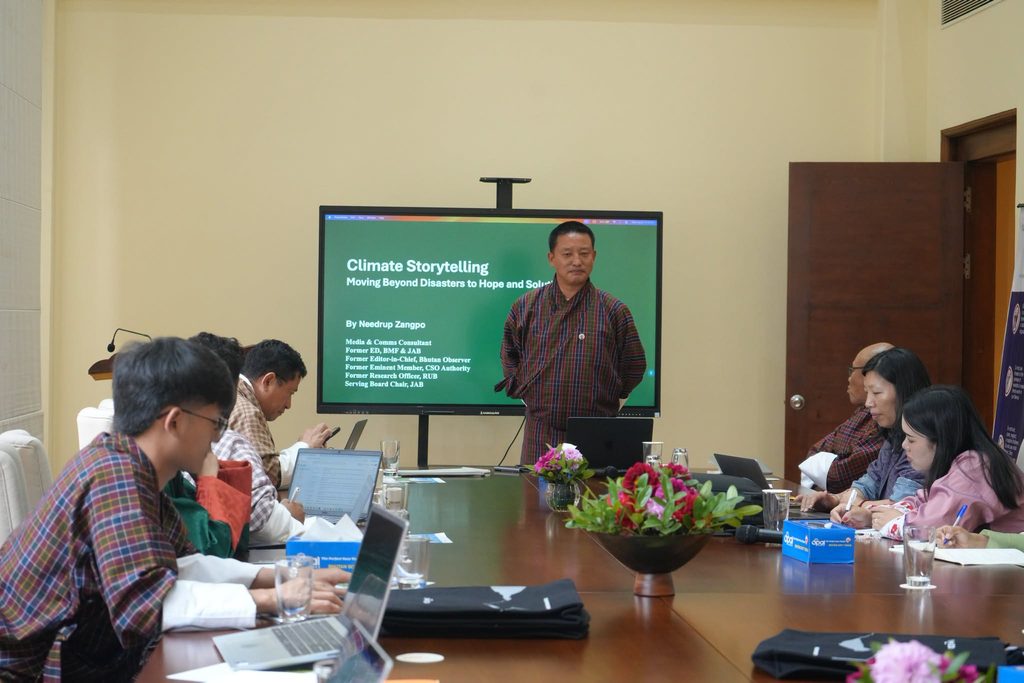
On 9th and 10th September 2026, Tarayana Foundation, in collaboration with ICIMOD, brought together Bhutanese journalists for a GESI-responsive Climate Storytelling Workshop at Terma Linca, Paro, under the HI-CAS project, with support from Global Affairs Canada.


The two-day workshop went beyond reporting climate change as a story of disasters and loss. It encouraged journalists to look deeper, to find the people behind the impacts, the voices often left unheard, and the locally led solutions creating hope and resilience.
Through practical exercises, story labs, discussions, and editorial challenges, participants explored how to:
 Tell human-centred, solutions-oriented climate stories
 Listen to voices that are often missing
 Bring gender equality and social inclusion into climate reporting
 Report with dignity, ethics and responsibility
 Turn community experiences into powerful stories of resilience
From “Tell the Story Differently” to “Whose Voices Are Missing?”, and from story makeovers to the 3-Minute Climate Story Pitch, journalists challenged themselves to see familiar climate issues through a different lens.
Because climate stories are not only about what is changing.


They are about who is experiencing that change, who is responding, whose knowledge matters, and whose voice needs to be heard.
As the workshop concluded with “One Story I Commit to Tell,” participants left not only with new storytelling tools but with a commitment to bring Bhutan’s climate realities and the voices of its communities to wider audiences.
Every community has a story. Every voice matters. And the way we tell these stories can help shape how we understand, respond to, and build resilience to a changing climate.